What Was at Stake for the Papacy in Commissioning Art for the Vatican?
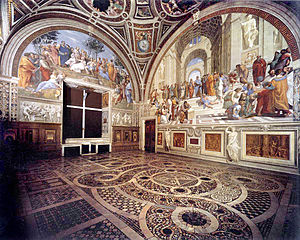
The Stanza della Segnatura
The four Raphael Rooms (Italian: Stanze di Raffaello) form a suite of reception rooms in the Apostolic Palace, now part of the Vatican Museums, in The holy see. They are famous for their frescoes, painted by Raphael and his workshop. Together with Michelangelo's Sistine Chapel ceiling frescoes, they are the 1000 fresco sequences that marking the High Renaissance in Rome.
The Stanze, as they are commonly called, were originally intended as a suite of apartments for Pope Julius II. He commissioned Raphael, then a relatively young artist from Urbino, and his studio in 1508 or 1509 to redecorate the existing interiors of the rooms entirely. It was peradventure Julius' intent to outshine the apartments of his predecessor (and rival) Pope Alexander VI, every bit the Stanze are direct above Alexander'southward Borgia Apartment. They are on the third floor, overlooking the south side of the Belvedere Courtyard.
Running from eastward to w, equally a visitor would have entered the apartment, but non following the sequence in which the Stanze were frescoed, the rooms are the Sala di Costantino ("Hall of Constantine"), the Stanza di Eliodoro ("Room of Heliodorus"), the Stanza della Segnatura ("Room of the Signatura"), and the Stanza dell'Incendio del Borgo ("The Room of the Burn down in the Borgo").
Afterward the death of Julius in 1513, with two rooms frescoed, Pope Leo X continued the program. Following Raphael'due south decease in 1520, his assistants Gianfrancesco Penni, Giulio Romano and Raffaellino del Colle finished the projection with the frescoes in the Sala di Costantino.
Scheme [edit]
The scheme of the works is as follows:
| General view (I) | General view (II) | Due east wall | Due south wall | W wall | North wall | Ceiling |
|---|---|---|---|---|---|---|
| Room of the Signatura | ||||||
| | | | | | | |
| The School of Athens | Cardinal and Theological Virtues | Disputation of the Holy Sacrament | The Parnassus | |||
| Room of Heliodorus | ||||||
 | | | | | | |
| The Expulsion of Heliodorus from the Temple | The Mass at Bolsena | The Meeting of Leo the Great and Attila | Deliverance of Saint Peter | |||
| Room of the Burn down in the Borgo | ||||||
| | | | | | | |
| Battle of Ostia | The Burn down in the Borgo | The Coronation of Charlemagne | The Oath of Leo III | |||
| Hall of Constantine | ||||||
| | | | | | | |
| The Vision of the Cantankerous | The Battle of the Milvian Bridge | The Baptism of Constantine | The Donation of Constantine | |||





Sala di Costantino [edit]
The largest of the twelve rooms is the Sala di Costantino ("Hall of Constantine"). Its paintings were not begun until Pope Julius and, indeed Raphael himself, had died. The room is dedicated to the victory of Christianity over paganism. Its frescoes correspond this struggle from the life of the Roman Emperor Constantine, and are the piece of work of Giulio Romano, Gianfrancesco Penni and Raffaellino del Colle. Because they are not past the master himself, the frescos are less famous than works in the neighboring rooms. Continuing a long tradition of flattery, Raphael's assistants gave the features of the electric current pontiff, Clement VII, to Pope Sylvester in the paintings.
The Vision of the Cross [edit]

The Vision of the Cross, 1520–1524
The fresco of The Vision of the Cross depicts the legendary story of a great cantankerous appearing to Constantine as he marched to confront his rival Maxentius. The vision in the sky is painted with the words in Greek "Εν τούτω νίκα" ("By this, conquer", better known as the Latin In hoc signo vinces) written next to it.
The Battle of Milvian Bridge [edit]

The Battle of Milvian Bridge, 1520-1524
The Battle of Milvian Bridge shows the battle that took place on October 28, 312, following Constantine's vision.
The Baptism of Constantine [edit]

The Baptism of Constantine, 1517–1524
The tertiary painting in the sequence, The Baptism of Constantine, was most probable painted past Gianfrancesco Penni, and shows the emperor being baptised by Pope Sylvester I in the Lateran Baptistery at Rome. This follows the account of Constantine's baptism given in the Acts of Sylvester and the Liber Pontificalis, rather than the alternate deathbed version recounted in Eusebius's Life of Constantine. In The Baptism of Constantine, Pope Sylvester I has the physical features of Pope Clement VII (1523-1534), who ordered the completion of the Raphael Rooms. [ane]
The Donation of Constantine [edit]

The Donation of Constantine, 1520–1524
The final painting in the sequence, The Donation of Constantine, records an event that supposedly took place before long after Constantine'due south baptism, and was inspired past the famous forged documents, incorporated into Gratian'southward Decretum, granting the Papacy sovereignty over Rome'southward territorial dominions.
Stanza di Eliodoro [edit]
The side by side room, going from East to West, is the Stanza di Eliodoro ("Room of Heliodorus"). Painted between 1511 and 1514, information technology takes its name from one of the paintings. The theme of this individual chamber – probably an audience room – was the heavenly protection granted by Christ to the Church building.[2] The four paintings are: The Expulsion of Heliodorus from the Temple, The Mass at Bolsena, The Meeting of Pope Leo I and Attila, and The Deliverance of Saint Peter from Prison. In the first two of these frescoes, Raphael flatteringly includes his patron, Pope Julius Ii, as participant or observer; the tertiary, painted subsequently Julius's death, includes a portrait of his successor, Leo X.
Raphael's style changed here from the Stanza della Segnatura. Instead of the static images of the Pope'south library, he had dramatic narratives to portray, and his approach was to maximize the frescoes' expressive effects. He represented fewer, larger figures so that their actions and emotions have more directly bear upon on the viewers, and he used theatrical lighting effects to spotlight certain figures and enhance tension.
The Expulsion of Heliodorus from the Temple [edit]
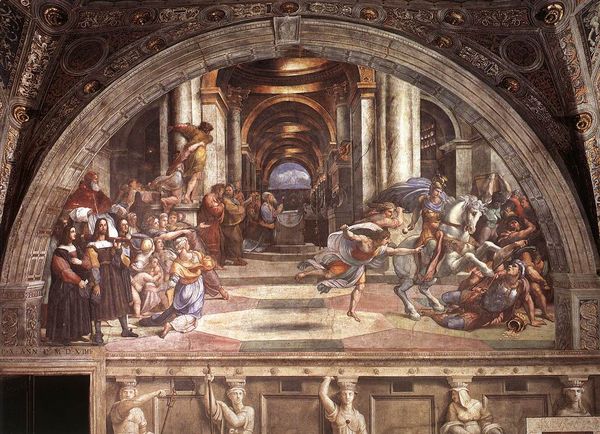
Raphael, The Expulsion of Heliodorus from the Temple, 1511–1513
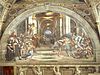
In The Expulsion of Heliodorus from the Temple Raphael illustrated the biblical episode from II Maccabees (3:21–28) virtually Heliodorus, who was sent to seize the treasure preserved in the Temple in Jerusalem, but was stopped when the prayer of the priest of the temple was answered past angels who flogged the intruder and an celestial rider who chased him from the temple. The composition is considerably more than dramatic than Raphael's earlier frescoes in the Stanza della Segnatura. Although the focal point is the even so figure of the priest at prayer, Heliodorus and the angels rush forrad into space, threatening to spill out of the painting. At the left Julius II, carried past the Swiss Guard in a chair, witnesses the event. His inclusion hither refers to his battles to prevent secular leaders from usurping papal territories.[iii]
The Mass at Bolsena [edit]

Raphael, The Mass at Bolsena, 1512
The Mass at Bolsena depicts the story of a Maverick priest who in 1263 ceased to doubt the doctrine of Transubstantiation when he saw the bread begin to drain during its consecration at Mass. The textile that was stained by the claret was held every bit a relic at the nearby town of Orvieto; Julius II had visited Orvieto and prayed over the relic in 1506.[iv] The Pope is portrayed as a participant in the Mass and a witness to the miracle; he kneels to the correct of the chantry, with members of the Curia (also portraits) standing behind him. Raphael distinguishes the "real" thirteenth-century witnesses from those who are contemporaries of the pope by their caste of date in the event; the latter concentrate calmly on Julius kneeling at his devotions rather than responding to the miracle.
The Meeting of Leo the Great and Attila [edit]

The Meeting of Leo the Cracking and Attila, 1514
The Coming together of Leo the Great and Attila depicts the storied parley betwixt the Pope and the Hun conqueror, and includes the legendary images of Saint Peter and Saint Paul in the sky bearing swords. A fully developed drawing by Raphael indicates he planned to place the pope – portrayed with Julius's features – in the groundwork; when Leo Ten became pope – and merely happened to cull the proper noun Leo – he must accept encouraged the artist to bring the pope forepart and center and utilise his own portrait.[5]
Deliverance of Saint Peter [edit]

Raphael, Deliverance of Saint Peter, 1514
The Deliverance of Saint Peter shows, in iii episodes, how Saint Peter was liberated from prison past an angel, every bit described in Acts 12. It symbolizes the power of the Vicar of Christ to escape homo restraints. Julius II's titular church every bit primal, before he was elevated to the papacy, had been S. Pietro in Vincoli (St. Peter in Chains), and so the painting is at once a general reference to the papacy and a specific reference to Julius.[6] The fresco is a study in light: natural moonlight, human being-made torchlight, and God-provided affections lite. It is the latter, of grade, that outshines the others.
Stanza della Segnatura [edit]
The Stanza della segnatura ("Room of the Signatura") was the first to exist decorated by Raphael's frescoes. It was the written report housing the library of Julius II, in which the Signatura of Grace tribunal was originally located. The creative person's concept brings into harmony the spirits of Artifact and Christianity and reflects the contents of the pope's library with themes of theology, philosophy, jurisprudence, and the poetic arts, represented in tondi in a higher place the lunettes of the walls. The theme of this room is worldly and spiritual wisdom and the harmony which Renaissance humanists perceived between Christian teaching and Greek philosophy. The theme of wisdom is advisable as this room was the council bedroom for the Apostolic Signatura, where well-nigh of the of import papal documents were signed and sealed.
Disputation of the Holy Sacrament [edit]

Raphael, Disputation of the Holy Sacrament, 1509-1510
The starting time composition Raphael executed betwixt 1509 and 1510[7] was the Disputation of the Holy Sacrament, the traditional name for what is actually an Adoration of the Sacrament. In the painting, Raphael created an image of the church, which is presented as spanning both heaven and globe.
The Parnassus [edit]

Raphael, The Parnassus, 1509-1511
Raphael completed the second limerick between 1509 and 1511.[8] It represents The Parnassus, the dwelling house place of the god Apollo and the Muses and the home of poetry, according to classical myth. In the fresco Apollo and the Muses are surrounded by poets from antiquity and Raphael'southward own fourth dimension.
The School of Athens [edit]
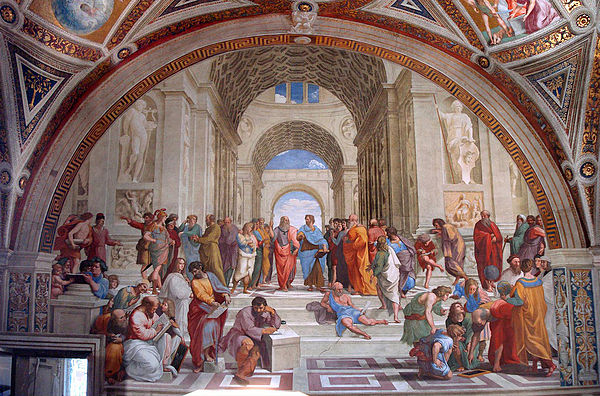
Raphael, The Schoolhouse of Athens, 1509-1511
Betwixt 1509 and 1511, Raphael as well completed some other work on the wall opposite the Disputa. This third painting,[9] entitled The School of Athens, represents the degrees of knowledge or the truth caused through reason. The fresco's position as well as the philosophers' walk in direction of the Holy Sacrament on the contrary wall suggested the estimation of the whole room as the move from the classical philosophy to the true religion and from the pre-Christian world to Christianity.[10] It was meant to reside over the philosophical section of Pope Julius II's library. It is mayhap Raphael's almost famous fresco.
The Primal Virtues [edit]

Raphael, The Central Virtues, 1511
The 2 scenes on the fourth wall, executed past the workshop, and the lunette to a higher place it, containing the Primal Virtues, were painted in 1511. The Cardinal Virtues allegorically presents the virtues of fortitude, prudence and temperance aslope charity, faith, and hope.
Stanza dell'incendio del Borgo [edit]
The Stanza dell'incendio del Borgo was named for the Burn in the Borgo fresco which depicts Pope Leo IV making the sign of the cross to extinguish a raging fire in the Borgo district of Rome about the Vatican. This room was prepared as a music room for Julius' successor, Leo X. The frescos draw events from the lives of Popes Leo Three and Leo IV. The other paintings in the room are The Oath of Leo III, The Coronation of Charlemagne past Leo III, and The Battle of Ostia. Though the Burn down in the Borgo was based on Raphael's mature designs it was executed past his assistants, who painted the other 3 paintings without his guidance.
The Adjuration of Leo Iii [edit]

The Oath of Leo 3, 1516–1517
On Dec 23, 800 AD, Pope Leo Three took an oath of purgation apropos charges brought against him past the nephews of his predecessor Pope Hadrian I. This issue is shown in The Oath of Leo III.
The Coronation of Charlemagne [edit]
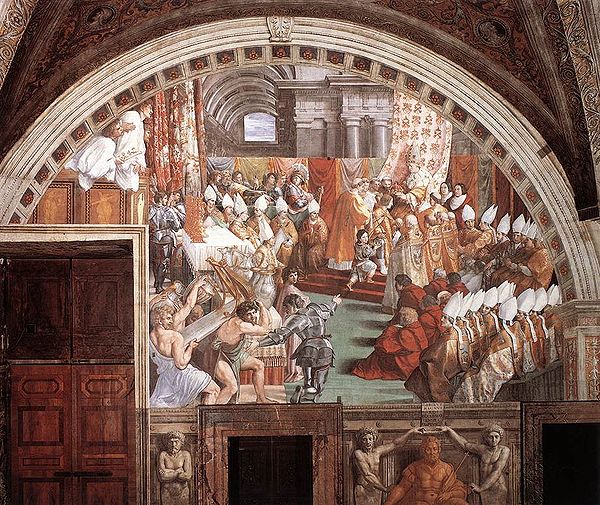
The Coronation of Charlemagne, 1516–1517
The Coronation of Charlemagne shows how Charlemagne was crowned Imperator Romanorum on Christmas Day, 800.
Burn down in the Borgo [edit]

The Fire in the Borgo, 1514–1517
The Fire in the Borgo shows an event that is documented in the Liber Pontificalis: a fire that bankrupt out in the Borgo in Rome in 847. According to the Catholic Church building, Pope Leo IV contained the fire with his benediction.
The Battle of Ostia [edit]

The Battle of Ostia, 1514–1515
The Battle of Ostia was inspired by the naval victory of Leo IV over the Saracens at Ostia in 849.
See besides [edit]
- Index of State of the vatican city-related articles
Notes [edit]
- ^ "Raphael | Stanze in the Palazzi Pontifici, Vatican | Podere Santa Pia, Holiday business firm in the south of Tuscany".
- ^ Roger Jones and Nicholas Penny, Raphael, New Haven, 1983, 113; Ingrid D. Rowland, "The Vatican Stanze," in The Cambridge Companion to Raphael, ed. Marcia B. Hall, Cambridge, 2005, 111.
- ^ Jones and Penny, 117; Rowland, 112.
- ^ Jones and Penny, 117; John Pope-Hennessy, Raphael, London, 1970, 112; Rowland, 113.
- ^ Jones & Penny, 118–121; Pope-Hennessy, 115.
- ^ Jones & Penny, 118; Rowland,112–113.
- ^ Raphael, Phaidon Publishers, 1948, p. 24.
- ^ Raphael, Marcia B. Hall (ed.), The Cambridge Companion to Raphael, Cambridge University Printing, 2005, p. 195.
- ^ Jones and Penny, p. 74: "The execution of the School of Athens ... probably followed that of the Parnassus."
- ^ One thousand. Smolizza, Rafael y el Amor. La Escuela de Atenas como protréptico a la filosofia, in Thought y Sentimiento. Itinerarios por el dibujo de Rafael a Cézanne, Barcelona, 2007, pp. 29–77
Further reading [edit]
- Rijser, David. "Tradition and Originality in Raphael: The Stanza Della Segnatura, the Eye Ages and Local Traditions." The Quest for an Appropriate Past in Literature, Art and Architecture, edited by Karl A.E. Enenkel and Konrad A. Ottenheym, vol. sixty, Brill, LEIDEN; BOSTON, 2019, pp. 106–126. JSTOR, world wide web.jstor.org/stable/10.1163/j.ctvbqs5nk.11. Accessed 24 Mar. 2021.
External links [edit]
- The Stanze of the Vatican - with virtual tour
- Visual Bout of the Raphael Rooms, with identifications of figures in frescoes
- Raphael Rooms' 360x180 caste panorama virtual tour
- The Vatican: spirit and art of Christian Rome, a volume from The Metropolitan Museum of Fine art Libraries (fully available online equally PDF), which contains material on the Raphael Rooms (pp. 111–123)
Source: https://en.wikipedia.org/wiki/Raphael_Rooms
0 Response to "What Was at Stake for the Papacy in Commissioning Art for the Vatican?"
Post a Comment